
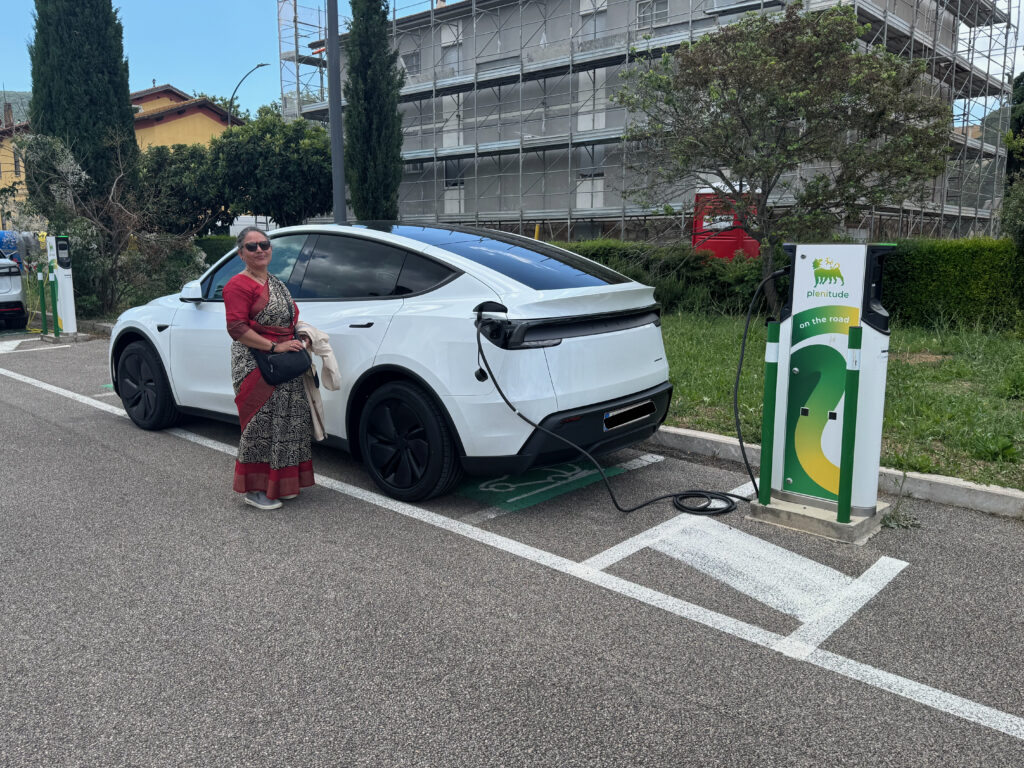
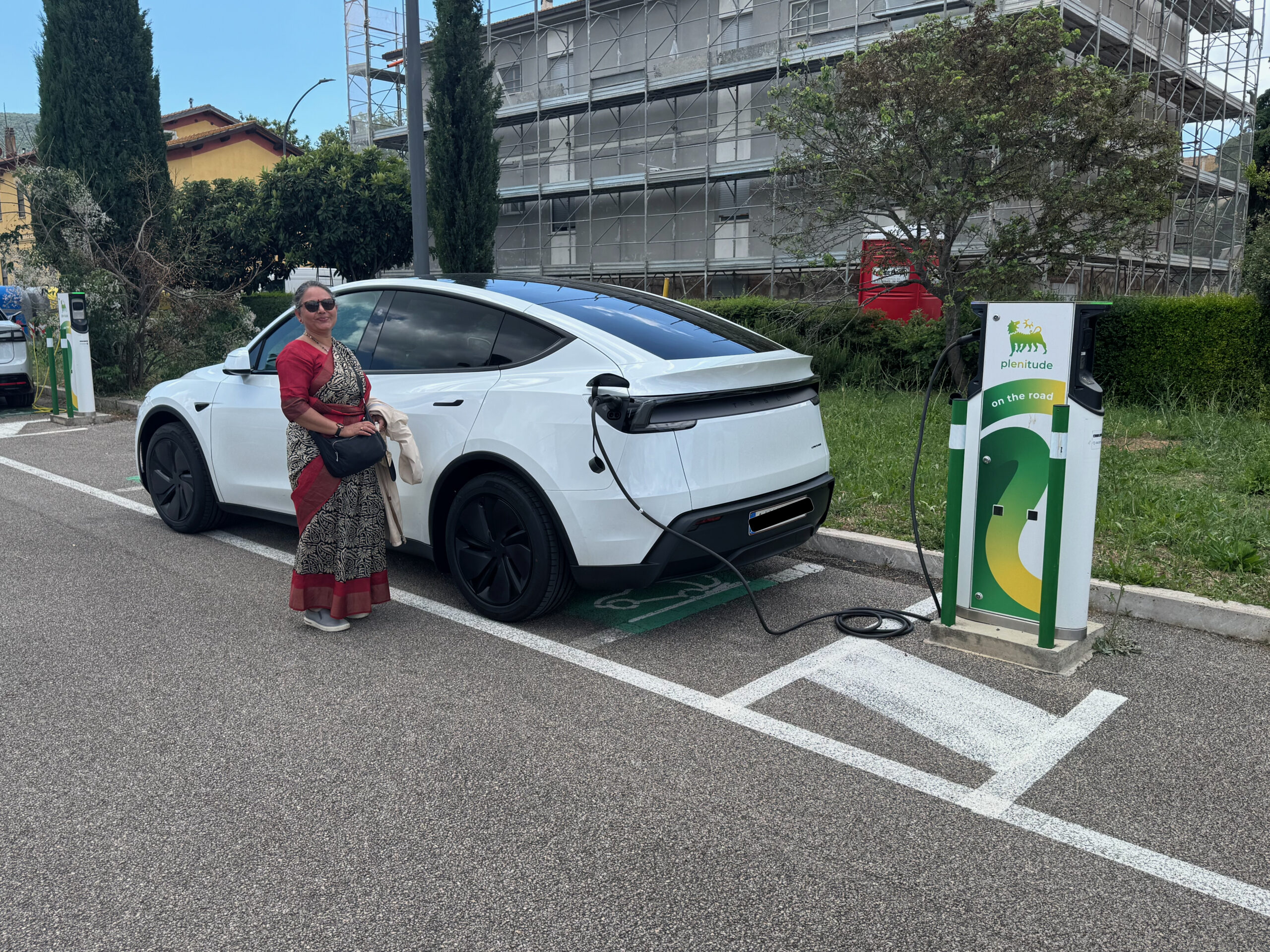
20 years ago, Chris Paine’s documentary Who Killed the Electric Car? argued that the electric car was not defeated by technology so much as by a coalition of interests and narratives, including the idea that battery-powered vehicles could not reliably get people from A to B without fossil-fuel backup. Kaberi and I have just completed two phases of our attempt to retrace the route of Rabindranath Tagore’s 1926 European tour in our 100% electric car. We were filming for a forthcoming series of special, Bengali-language episodes of The Waterfall to mark the centenary of Tagore’s tour and show the modern day relevance of his experiences.
Over a period of four weeks, we visited Tagore-related locations in Rome, Florence, Turin, Villeneuve (Switzerland), Zürich, Munich, Vienna, Balatonfüred, Zagreb, Belgrade, Sofia, Bucharest, Budapest, Prague and Nürnberg. Starting from Brussels on 31 May 2026 (100 years after Tagore landed in Naples on 29 May 1926 and caught a train to Rome), we covered 8,098 kilometres – just over 5,000 miles – demonstrating in the process that there is no practical need for a hybrid car in Europe today, even when the route includes countries with thinner Tesla Supercharger coverage such as Bulgaria, Romania and Serbia.
Our journey followed the parts of Tagore’s 1926 European tour through western, central and south-eastern Europe. So it went well beyond the dense charging corridors of Germany, France or the Netherlands to include less obvious EV territory, in the Balkans and Black Sea region, making use of local charging point networks.
Others have documented long distance electric drives in recent years, such as an 8,153km father-and-son trip from Munich to the North Cape and back in 17 days, using the Tesla Supercharger network throughout, and another journey of about 3,500 miles across Europe with a full breakdown of charging, tolls and multi-country logistics.
Charging beyond the Tesla Supercharger network
Of course, not that every part of Europe has perfect charging infrastructure. Even so, we demonstrated that this no longer prevents cross-border travel in a fully electric car.
In areas where Tesla’s own network was not available, charging and payment were handled through the Electroverse app provided by Octopus, the energy provider of our house in London. Octopus describes Electroverse as a roaming service that lets drivers pay across multiple charging networks through one account, with charging costs consolidated into a single bill. Electroverse now gives access to more than 1.4 million public charging points across Europe, which they claim makes it Europe’s largest charging network.
Combined with the over 1,200 Tesla Supercharger locations in 30 European countries (with over 15,000 charging stations), most of which are open to vehicles from brands other than Tesla, there is no longer any basis in Europe for the “you need a hybrid just in case” argument.
Why hybrids are not the answer
The case against the hybrid is not only philosophical. It is also technical.
A battery-electric car has a fundamentally simpler drivetrain than a vehicle with an internal combustion engine, with fewer moving parts and a less complex transmission layout. In contrast, a hybrid, car still carries an internal combustion engine and its associated systems while also adding an electric motor, battery and power electronics to manage the complexity of combining the two propulsion systems.
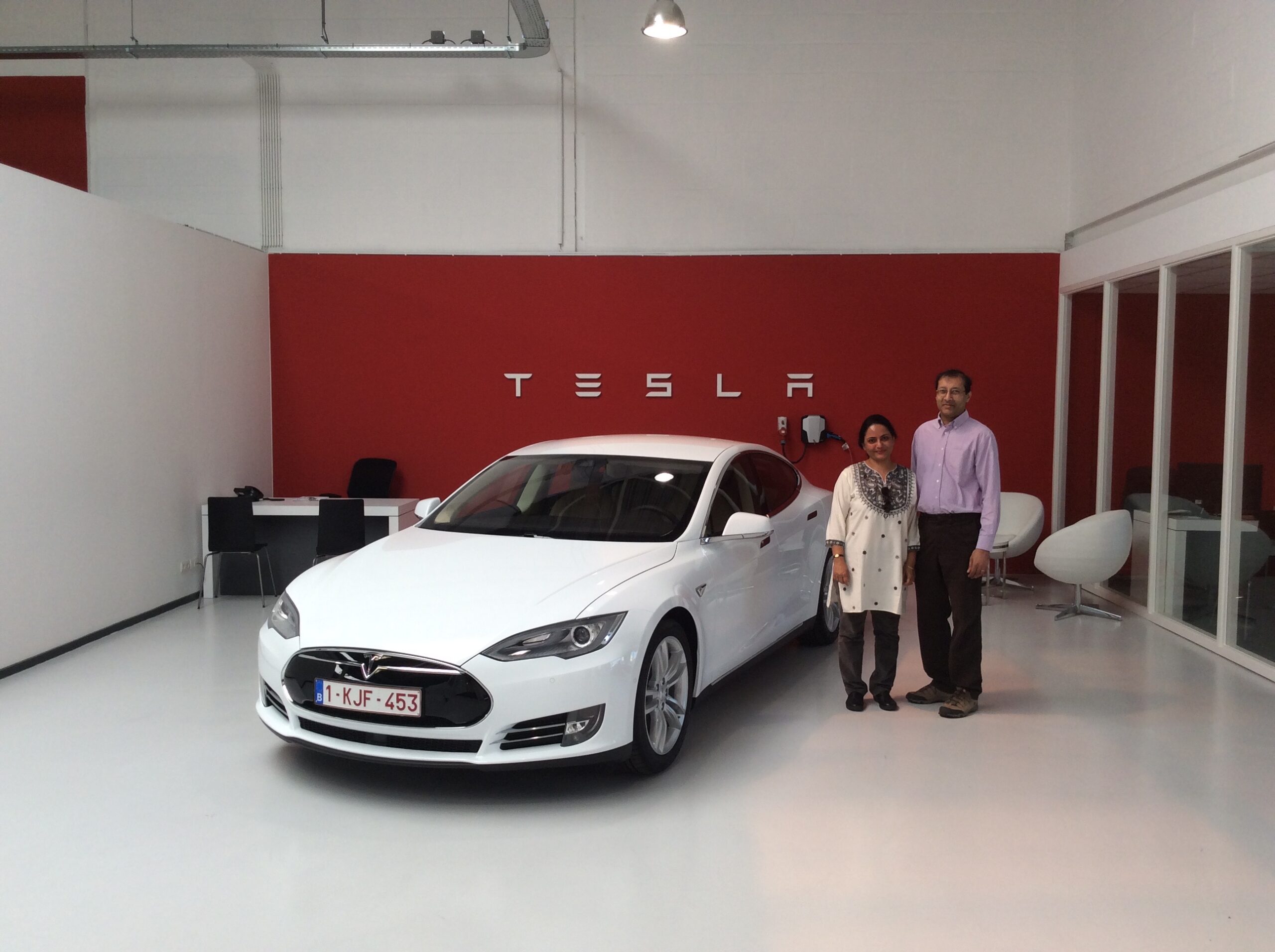
Some hybrids, such as the Honda Insight we used to own before going fully electric with our first Tesla Model S in 2015, cannot be driven without running the internal combustion engine. Others allow a (sometimes very) limited range of purely electric driving before the internal combustion engine takes over.
Either way, they need conventional engine maintenance such as oil and filter changes, coolant checks and other ICE-related servicing. By comparison, as we know from our own experience over the past 11 years, EVs benefit from mechanical simplicity and fewer routine service items.
Renewable energy, not fossil fuel dependency
There is another side to this story that discussions of range anxiety often miss: energy sourcing. By using Electroverse, we were able to offset some of our charging costs against credits from Octopus generated by the solar panels on the roof of our house in London. As a result, whatever charging we did beyond Tesla’s supercharger network (which is powered by renewable energy, either generated on-site or through renewable energy matching) was financed by self-generated renewable energy.
In contrast, petrol or diesel cars (including hybrid cars) depend on a commodity whose price has proven to be susceptible to war, supply chain disruption, refinery capacity, and geopolitical shocks. Toyota’s global car sales fell 7.2% year-on-year in May, its fourth consecutive month of declining sales, which the company and commentators linked to weak demand in several regions and a challenging market environment, including rising gasoline prices.
The range anxiety now facing drivers of fossil-fuel-powered vehicles may no longer be whether the car can physically go the distance. It may rather be where the next petrol station with fuel will be and, if it has fuel, whether the price will have gone up again.
Myths that belong to a bygone era
If the myth that cars are somehow incomplete without a petrol engine hidden inside them was ever true, our experience not only on this road trip but over the almost 270,000km we have driven around Europe over the past 11 years in our two previous electric cars (instead of flying) demonstrates that it is certainly no longer true today. There is clearly a gap between the technical reality and the messaging of a fossil fuel industry keen to discourage drivers from abandoning its products.
Teresa Ribera, Executive Vice‑President of the European Commission for a Clean, Just and Competitive Transition, put that wider problem starkly in her comments on the latest European heatwave:
“What we are experiencing today [in the form of record heat] is what we knew could happen, but we have not been smart enough to address the root causes. There is still this fierce fight against facts, science, preparedness, and investment [in clean energy], so we are failing people. We need to reject this kind of bullshit based on lies, and against people’s interests.
“These narratives don’t appear from nowhere. They are promoted by those who benefit from delaying the transition and keeping us locked into fossil fuels – even when the alternatives already work.” – European Commission Vice-President Teresa Ribera





One response to “Exploding the hybrid car myth”
[…] in sales of second-hand Tesla cars all over Europe for the past decade. As I mentioned in my previous post, we drove over 8,000km in our new Tesla Model Y last month. Nikola Brussels are currently handling […]